Welcome to the CBE Research Roadmap! Whether this is your first research project or you’re a seasoned expert, we hope you find helpful resources for every step of your process.
Interested in starting a research proposal to be submitted through OSP? Submit a proposal planning intake form.
Pre-Award Process Diagram
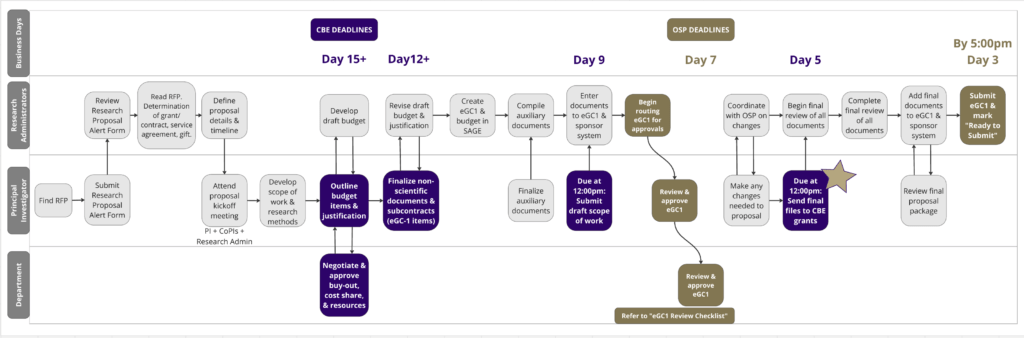
It is recommended that you start 8-12 weeks before a funding proposal deadline. We will not be able to successfully process a proposal with less than 4 weeks before the funding proposal deadline. All final documents are due 5 business days before the funding proposal/sponsor deadline.
Getting Started with Research at UW
The UW Office of Research provides a slew of resources. To begin, visit the following pages:
- UW Office of Research home page – providing leadership and support to UW’s research community.
- New to UW Research – things every new researcher needs to know and do.
- MyResearch Project Lifecycle – an excellent, thorough navigation of research activities and resources through all phases of the project lifecycle from proposal submission to closeout.
CBE research onboarding:
- Research Overview meeting with the Associate Dean for Research (email be-research@uw.edu).
- Mentorship around proposal development, funding opportunities, and research strategy is available by appointment with the Associate Dean for Research (email be-research@uw.edu).
- Email be-grants@uw.edu to schedule an onboarding session with the CBE Grants Administration Team.
The UW Office of Research compliance and trainings:
Everyone conducting research at the UW needs to comply with internal and external requirements; luckily, the UW Office of Research provides information and training to ensure the safety and minimize risk to the researcher.
Examine the requirements at this Compliance Overview page. Sign up for the Mandatory Compliance Trainings, covering topics like:
- Grants Management for Investigators course: Researchers submitting a proposal as UW Principal Investigator for the first time must attend a workshop within twelve months of submitting the proposal via SAGE, if they have not attended one previously. First-time PIs are strongly encouraged to attend a workshop before submitting the proposal. This training is required every 4 years.
- Financial Conflict of Interest: Investigators participating in, or applying for, Public Health Service (PHS)-sponsored research are required to complete this training for compliance with PHS regulations. However, all UW personnel participating in research are encouraged to complete this training module. Training is required every 4 years.
- Other Required Training: Applicable when working with animals, human subjects, clinical trials, HIPAA, controlled substances and specific sponsors.
- For federal awards: Research Security Training (Combined) basic. (The combined basic course, 1 hour, meets this requirement.)
- Human Subjects training (see below).
Will your research involve human subjects, in any capacity? If your research will involve “a living individual about whom an investigator conducting research obtains:
- data through intervention or interaction with the individual, or
- identifiable private information”,
you will likely need to have your proposal reviewed by the Institutional Review Board (IRB).
The UW Human Subjects Division provides “getting started” resources regarding IRB applications on their webpage. View the on-demand, e-learning tutorial about getting started with IRB. This short tutorial is required for students who are listed as the principal investigator (PI) on an IRB application. In addition, view the FAQ page, which covers questions about turnaround times for new applications and how to submit.
For further questions, email the Human Subjects Division at hsdinfo@uw.edu. More information and mandatory forms can be found at the Human Subjects Division website.
Resources:
- CBE technology resources include:
- The Institution for Translational Health Sciences provides resources for investigators, including a survey tool
- The UW Community Engagement Knowledge Hub supports community engagement in research at UW.
- The UW Health Sciences Library has a range of resources for research and grant writing.
Research Admin Tools can be found on the UW Office of Research website.
- Collaborative for Research Education (CORE): Instructor-led, eLearning focused on research administration
Intellectual Property refers to property rights in ideas that are protected through federal and state laws governing patents, copyrights, and trade secrets. Know-how is sometimes also included in intellectual property licenses, and covers ideas and information that is not protected by patent, copyright or trade secret.
The value of intellectual property (IP) is not only in the original idea, but in how that idea is protected through copyright, patent or trademark rights. To appropriately and diligently protect IP created at the UW, we use a management strategy that provides our licensees with the freedom they need to meet their strategic business needs, while giving the UW enough control to ensure the IP is as robust and broad as possible throughout the entire life cycle of the innovation.
- GIM 40 covers Intellectual Property in Sponsored Programs. According to GIM 40, Intellectual Property (IP) created by UW Employees and Agents in the course of carrying out a Sponsored Program is a state asset, subject to control by statute, regulation, other law, and policy.
- CoMotion handles intellectual property licensing, protection and advising at the UW in accordance with the Patent, Invention, and Copyright Policy, Executive Order 36, which discusses how and when intellectual property is assigned to UW, and how it is managed.
- There are a variety of success stories in getting technologies from the UW to the market, and they follow any of four paths to market: startups, direct licensing to industry, direct-to-user licenses, and programs & projects.
Plan & Propose
- Check our Funding Opportunities page to for a list of funding databases and other ways to identify funding opportunities. Resources in CBE include:
- Funding Search Support Form
- Recommendations for relevant centers and organizations across campus, listservs, funders, and foundations to follow for funding opportunities
- Schedule office hours with the Associate Dean for Research to help identify funding opportunities by emailing be-research@uw.edu
Review the CBE Research Roles and Timelines policy and procedure document.
- READ THE RFP IN DETAIL. It is the responsibility of the Principal Investigator (PI), i.e., the person intellectually leading a proposal, to understand and address all substantive aspects of the funder’s solicitation, to create, oversee and approve all of the materials for the proposal, and to respond to grant administrators’ questions as they support the PI in submitting a proposal.
- REVIEW DATES AND DEADLINES as specified in the Research Roles and Timelines policy and procedure, and the Pre-Award Process Diagram above.
- ELIGIBILITY AND REQUIREMENTS – What are the requirements for the proposal, including PI eligibility, sub-awards, cost-sharing, indirect cost rates, etc., and are they compatible with your proposed project?
- FUNDING DETERMINATION – If you are unsure if the funding opportunity falls under a service, sponsored program, or gift, email the RFP to be-grants@uw.edu for them to review and make the determination. Failure to make the correct determination early-on can result in re-work, missed deadlines, or the inability to complete the proposal.
- If this is a LIMITED SUBMISSION: grants, awards, and fellowships that limit the number of applications coming from one institution. If the opportunity you are applying for falls under this category, you will need to add additional time to your timeline so the Office of Sponsored Programs has adequate time to review your proposal. Click here for a thorough – though not complete – list of Limited Submission opportunities.
Unsure if the funding opportunity is the right one for you? This go/no-go evaluation matrix may help. Contact us at be-research@uw.edu to discuss.
CBE researchers starting a proposal submission should submit a proposal planning intake form, which will be routed to the CBE research administration team for review and response.
Note, those who work with CSDE on their grants/contracts should fill out CSDE’s proposal intake form.
As you are writing your proposal, remember to discuss Cost Share and Buy-Out, and any other resource commitments with your department Chair. See the Pre-Award Process diagram above for timelines related to these conversations, as well as the CBE Office of Research Policy and Procedures.
Helpful resources:
- Preparing a Proposal: UW Office of Sponsored Programs (OSP) provides information on preparing your proposal, budget development, subawards, eGC1s, and sponsor-specific guidelines.
- A Guide for Proposal Writing (National Science Foundation): This guide covers all the steps necessary to write a thorough and complete proposal. Also includes tips on what makes an outstanding proposal—from a reviewer’s perspective.
Review the Community Engagement Knowledge Hub resources related to working with and paying community partners.
Review the Office of Research resources for preparing a data use agreement.
Review the Office of Research resources for research security.
Check training requirements from the funder. Ensure you have completed your research security training requirements.
If you are working with either the CBE research administration team or CSDE, the grants manager will submit your proposal and create an eGC1 form through SAGE. Interested in starting a research proposal to be submitted through OSP? Submit a proposal planning intake form. Note, those who work with CSDE on their grants/contracts should fill out CSDE’s proposal intake form.
You will want to get your eGC1 in early so that it can be routed to the appropriate people for approval prior to reaching OSP. The Chair and Dean for every PI involved in your research will need to review and sign off on your proposal. See the eGC1 Checklist for the review details.
Adhere to the deadlines in the CBE Research Roles and Timelines policy and procedure.
Setup
If you receive any notification regarding your award, please forward that information to be-grants@uw.edu.
Examples:
- Notification of award.
- Notification of declined award.
- Notification from lead PI of award decision.
- Notification of invitation to interview or submit a full proposal.
If you are selected to receive the grant, an Award Note will be sent to OSP. At this point, OSP will create a Funding Action and hand your grant off to Grant and Contract Accounting (GCA), who will create a budget number for your grant. Please note that it may take up to four weeks from the issuing of an Award Note to the time when a budget number is created and you can access your grant funds.
Manage
Review the CBE Services for Research page on other available support for managing an ongoing project.
Once you are awarded a grant and receive your Worktags, you can track and view your expenditures in the PI Dashboard in Workday. You can also run the individual reports yourself. Below are videos, presentations, and job aids on how to run the three most popular expenditure reports.
R1234: Grant Budget vs. Actuals
This report is for seeing a particular month and total amount on sponsored awards only.
Job Aid | Presentation | Video
R1306: Standard Budget vs. Actuals
Allows you to view expenses for a particular month and fiscal year to date. Works for all worktag types.
Job Aid | Presentation | Video
R1287.3: Income Statement – Month over Month Trending
Allows for seeing expenses on a month-to-month basis for all worktag types.
To view the status of invoices from your sponsor, visit Award Portal.
Closeout
Below is a typical schedule to be aware of when closing out your grant.
6 Months from End Date:
Subawards: Be aware of subaward spending to ensure they will complete the necessary work and submit invoices on time. If changes need to be made, now is the time to start the process to ensure the subaward and you have enough time for the changes to take effect.
Equipment purchases: At this point, equipment (like computers) should not be purchased unless you have sponsor approval. With this little time left in your award, these types of purchases do not have enough time to benefit the grant they are purchased on.
No Cost Extension: Start to look at your budget and projection and make sure you will spend out the remaining balance and complete the necessary work. If not, start the conversation with your sponsor about getting a no cost extension.
3 Months from End Date:
Subawards: By this time, the only changes to subawards should be extensions (if sponsored approved). Subawards should be finishing up and submitting invoices to close up the award.
No Cost Extension: Continue to monitor your award to determine if a no cost extension is necessary.
2 Months from End Date:
No Cost Extension: CBE’s deadline to submit the No Cost Extension form is 50 days before the award end date, so you should know if your sponsor will allow and if you need an extension. Make sure you submit the request by the 50 day CBE deadline so the grant team can notify OSP by their 45 day deadline.
1 Month from End Date:
If you are not getting an extension, below is a brief list of things to do before the award ends.
- Check to make sure you know what final reports the sponsor needs
- Confirm with grant team how final financial reports will be handled. Some sponsors will accept GCA’s report, while other sponsors have their own format.
- Work with the finance team to closeout of Purchase Orders, spend authorizations, and other unused encumbrances on your worktag
- At this point, your subawards should be wrapped up and if they have not submitted a final invoice, we should know when the final invoice will be submitted. The process for receiving and approving invoices takes time, so we need to be on time for invoices to prevent non-payments.